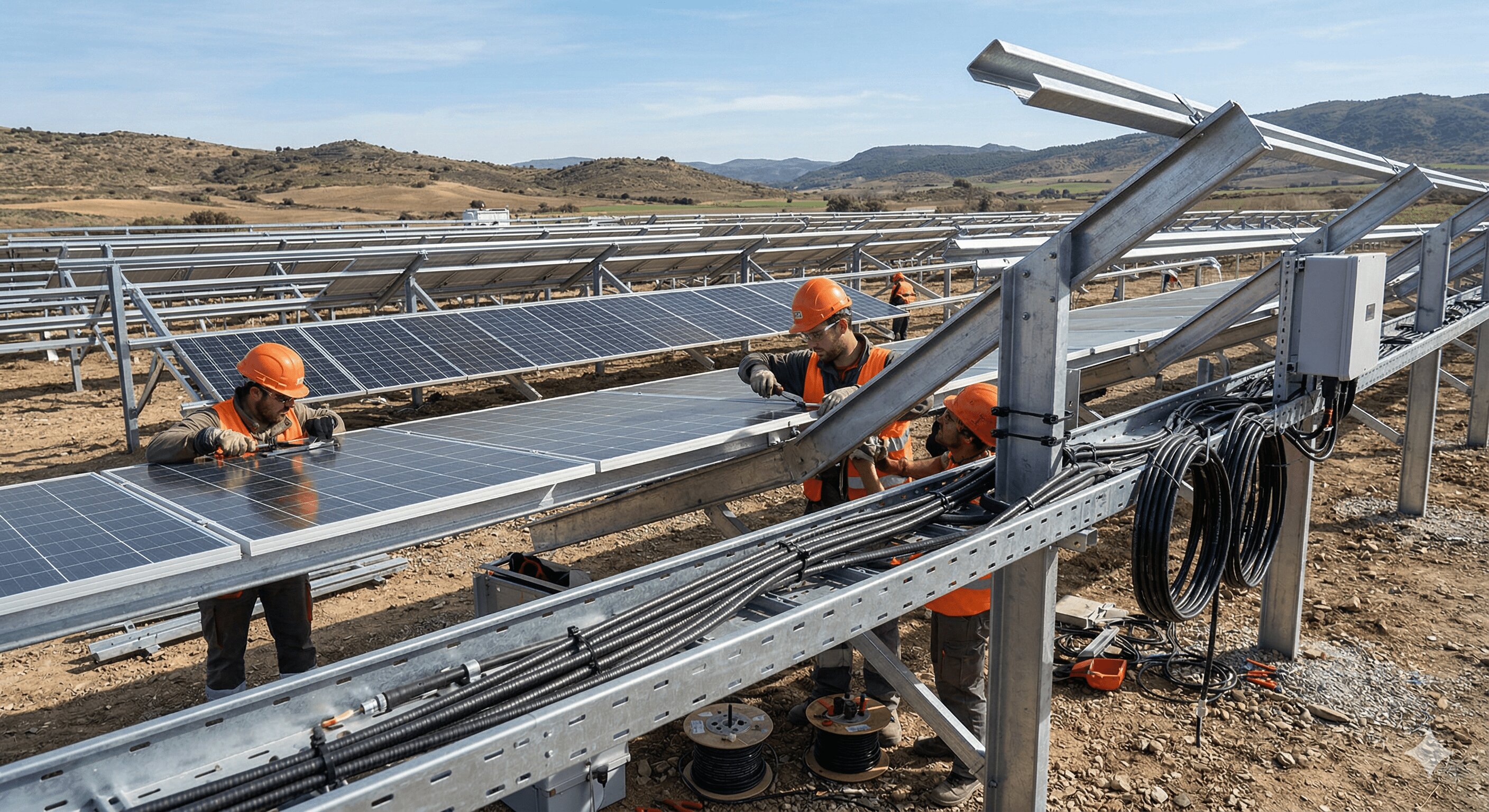
Solar EPCs are building India’s energy future — but most can’t get a working capital loan to buy the materials they need. Here’s exactly why banks fail this segment, and what’s changed.
You won the tender. The client has signed. The site is ready. And then your bank says no.
For thousands of mid-size solar EPC companies in India, this is not an edge case. It is the norm. Despite executing crores of project work, despite having signed contracts in hand, despite GST-compliant books and a clean credit history — the working capital loan application comes back rejected, delayed, or structured in a way that is practically useless.
This is not a story about bad EPCs. It is a story about a broken credit system that was never designed for how project-based businesses actually work.
The Working Capital Problem Every Solar EPC Faces
A solar EPC project is fundamentally a cash flow mismatch problem. To execute a 2MW ground-mount project, you need to procure materials — cables, inverters, mounting structures, panels, BOS components — before a single rupee arrives from your client. Vendors want advance payment. Logistics wants payment at dispatch. But your client pays at milestones: civil completion, mechanical completion, commissioning.
The gap between when you pay your suppliers and when your client pays you is typically 30 to 90 days. On a ₹5 crore project, that is ₹3 to ₹4 crore of working capital that needs to come from somewhere — before the project even starts generating revenue.
According to the Alvarez & Marsal Sunrise MSME report (2026), solar EPC contractors and equipment suppliers operate on milestone-based payment cycles, often facing working-capital gaps between project execution and payment realisation — a problem the report describes as structurally invisible to most traditional lenders.
The math is clear. The solution should be straightforward. And yet, for the vast majority of mid-size EPCs in India — companies doing ₹20 to ₹100 crore of annual project work — formal working capital credit remains largely inaccessible.
Why Banks Fall Short for Solar EPCs — 5 Structural Reasons
This is not a matter of banks being unwilling. It is a matter of banks being structurally unequipped. Here are the five specific reasons the traditional banking model fails solar EPCs.
1. Banks underwrite the past. Solar EPCs need credit for the future.
A bank’s credit assessment is built entirely on backward-looking data — audited financials, ITR filings, CIBIL scores, balance sheet strength. The problem is that a mid-size solar EPC’s balance sheet tells very little about its actual creditworthiness. Revenue is lumpy, milestone-driven and project-specific. A company that did ₹8 crore last year and has ₹25 crore of signed orders this year looks far more creditworthy than its balance sheet suggests — but a bank credit committee only sees the ₹8 crore.
What predicts an EPC’s ability to repay is not its balance sheet. It is the quality of its current project pipeline, its procurement discipline, its delivery track record and its client relationships. Banks have no framework to assess any of these things.
2. Collateral requirements are designed for asset-heavy businesses — not EPCs.
Traditional working capital loans require collateral — property, fixed assets, machinery. Solar EPCs are asset-light businesses. Their primary asset is their project pipeline and their execution capability, neither of which can be pledged to a bank.
The installed solar plant belongs to the client, not the EPC. The materials are procured for a specific project and delivered to site. There is no warehouse full of inventory that can be hypothecated. For a bank that needs something tangible to lend against, an EPC is a difficult proposition.
This is why even CGTMSE — the government’s credit guarantee scheme — which is technically designed to enable collateral-free loans, comes with its own friction: documentation requirements, processing timelines and eligibility conditions that most growing EPCs find difficult to navigate while running active projects.
3. Loan processing timelines do not match project procurement windows.
A typical bank working capital loan takes 4 to 8 weeks to process from application to disbursal. On a competitive solar EPC project, the window between signing a contract and needing to issue purchase orders to suppliers is often 2 to 3 weeks. By the time the bank has processed the application, the EPC has already either delayed the project — damaging the client relationship — or sourced materials on expensive informal credit from distributors and vendors.
The Tata Nexarc EPC Payment Cycle report (2026) documents this specifically: RA bill approval delays, retention money lock-ins and multi-level client approvals mean that even when milestone payments do arrive, they arrive late. A lender that takes 6 weeks to approve a loan and expects a fixed monthly repayment is fundamentally misaligned with a business that bills quarterly based on site progress.
4. Loan sizes do not match EPC requirements.
Government-backed schemes like MUDRA, SIDBI Green Finance and SBI Surya Shakti provide loans in ranges that simply do not cover the working capital needs of a mid-size solar EPC.
MUDRA loans go up to ₹10 lakh — useful for a micro EPC doing residential rooftop installations, not for a company executing a 2MW ground-mount project. SIDBI’s scheme goes up to ₹5 crore, but requires documentation and processing that takes months. A mid-size EPC doing a ₹5 crore project needs ₹3 to ₹4 crore of working capital — in a timeframe measured in weeks, not months.
The loan products exist on paper. But the size, speed and structure of those products are not calibrated to the actual working capital requirement of a functioning mid-size EPC.
5. Repayment structures are built for monthly cash flows — not project milestones.
A bank loan comes with a fixed EMI schedule. A solar EPC project generates cash in irregular milestone tranches — 20% on civil completion, 30% on mechanical completion, 40% on commissioning, 10% on grid connectivity. These tranches arrive weeks or months apart, and their timing is entirely outside the EPC’s control — it depends on the client’s internal approval process, DISCOM inspection schedules and sometimes monsoon delays on site.
An EPC paying a monthly EMI on a loan it took for a project where the client is 6 weeks late releasing a milestone payment is not a defaulter. It is a business operating in a structural mismatch between how it earns and how the bank expects it to repay. Banks do not distinguish between the two.
The Real Cost of the Credit Gap
When formal credit is unavailable or too slow, EPCs turn to alternatives — and every alternative has a cost that ultimately gets absorbed into the project.
Distributor credit at embedded interest: Most solar material distributors extend informal credit — but they embed an annualised cost of 18 to 24% into their pricing. An EPC that “buys on credit” from a distributor is paying a significant premium on every material purchase, without seeing it as an interest rate. This erodes project margins silently.
Delayed project starts: When working capital is unavailable, EPCs delay issuing purchase orders — waiting until they have internal cash. That delay pushes back material delivery, which pushes back site mobilisation, which pushes back milestone billing, which further tightens cash flow. One delayed tender becomes a cascading cash flow problem across the project pipeline.
Inability to take on more projects: The most damaging consequence is the growth ceiling the credit gap creates. An EPC that has successfully executed 5 projects a year has the capability to execute 8. But without working capital credit, it cannot take on project 6 without finishing project 4 and collecting the final milestone first. Capital, not capability, becomes the binding constraint on growth.
According to Aerem Solutions at the Green Finance Week India 2026, nearly 90% of MSMEs in the solar sector remain unable to access formal financing — a staggering figure given the scale and momentum of India’s solar capacity addition.
What Actually Works — Supply Chain Finance for Solar EPCs
The fundamental insight is this: the credit gap exists not because EPCs are uncreditworthy, but because the data that makes them creditworthy is invisible to banks.
A bank sees a balance sheet. It cannot see that this EPC has placed 47 verified purchase orders in the last 12 months, paid every vendor on time, completed 6 projects with zero delivery failures and has ₹8 crore of signed contracts waiting to be executed. That procurement and execution data is the real credit signal — and it does not exist in any format that a bank credit committee can assess.
Supply chain finance changes the underwriting model entirely. Instead of lending against a balance sheet, it lends against procurement behaviour — deploying credit at the point of purchase, tied directly to a specific verified order with a verified supplier, with repayment aligned to the project’s actual milestone cash flows.
This is precisely what FynCred is built to do. Every time a solar EPC sources materials through Fyntrade’s procurement platform, that transaction becomes a credit signal. Order frequency, supplier relationships, delivery track record, payment discipline — all of this builds a Fyntrade Credit Intelligence (FCI) Score that reflects the EPC’s actual creditworthiness, not just its last three years of audited financials.
Credit is then deployed at the exact moment it is needed — at the point of placing a purchase order — with repayment aligned to project milestone payments, not a fixed calendar EMI.
The result: materials reach the site on time. Projects bill on schedule. Cash flows align. And the EPC can take on the next project before the previous one fully closes — breaking the growth ceiling that the working capital gap creates.
The Checklist — What To Look For In Working Capital Finance For Your EPC
If you are evaluating working capital options for your solar EPC, here is what actually matters:
- Speed of deployment: Can credit be deployed within the procurement window — days, not weeks?
- Alignment with procurement: Is credit tied to specific purchase orders, or is it a general-purpose loan that requires separate management?
- Repayment structure: Does repayment align to your project milestones, or is it a fixed EMI regardless of when your client pays?
- Collateral requirement: Is credit available without pledging property or fixed assets?
- Credit limit growth: Does your credit limit grow as your procurement history builds — rewarding consistent execution?
- Underwriting basis: Is the lender looking at your project pipeline and procurement behaviour, or only at your balance sheet?
A working capital product that fails on any of these criteria is likely to create as many problems as it solves.
Key Takeaway
The working capital problem for solar EPCs in India is not going away on its own. Banks are not going to restructure their underwriting models for a segment they find difficult to assess. Government schemes provide some relief at the micro end of the market, but the 3,200+ mid-size EPCs doing ₹20 to ₹100 crore of project work annually remain largely underserved by formal credit.
The solution is not a better bank loan. It is a fundamentally different model — one that embeds credit directly into procurement, underwriters against forward-looking signals rather than backward-looking financials, and aligns repayment to the way project-based businesses actually generate cash.
That model exists. And for solar EPCs in India, it is called supply chain finance.
See how FynCred gives solar EPCs working capital without bank visits or collateral → Explore FynCred