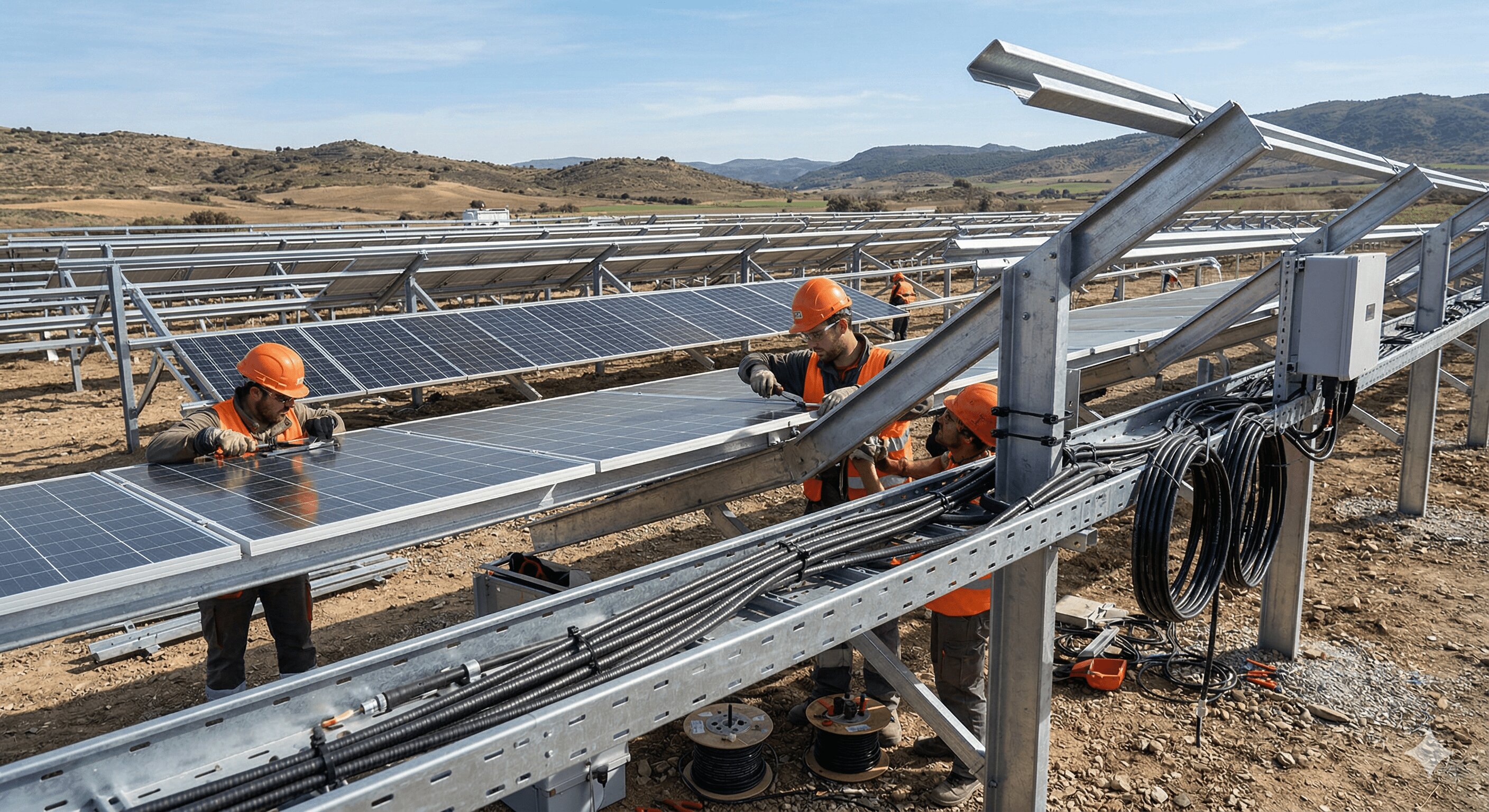
BOS components make up 20–30% of your solar project cost — but most EPCs treat procurement as an afterthought. Here’s how to get it right, every time.
Ask most solar EPCs where procurement goes wrong on a project and they’ll say modules or inverters — the big-ticket items everyone watches closely.
But ask them where projects actually stall on site — where commissioning gets delayed, where re-work happens, where engineers are standing idle waiting for parts — and the answer is almost always the same:
Balance of System.
A missing MC4 connector. An earthing compound that wasn’t ordered. A weather station that arrived without mounting hardware. A cable tray specification that didn’t match the site layout. Small things. Cheap things, individually. But collectively, they are the most common source of last-mile delays in solar project execution.
This guide is for purchase managers who want to get BOS procurement right — systematically, not reactively.
What Exactly Is Balance Of System?
Balance of System (BOS) refers to every component in a solar project that is not the PV module itself. It is everything that makes the plant work — the structural, electrical and monitoring components that connect, protect, measure and ground the system.
For a typical ground-mount solar project in India, BOS breaks into five broad categories:
Structural BOS
Module mounting structures, foundations (driven piles or ground screws), module clamps, end clamps, mid clamps, inter-row bracing.
Electrical BOS
DC cables, AC cables, MC4 connectors, cable trays, conduit pipes, junction boxes, string combiner boxes, DCDB, ACDB.
Earthing & Lightning Protection
Earth pits, earth enhancement compounds, copper bonded earth rods, lightning arrestors, earth conductors, equipotential bonding strips.
Monitoring & Instrumentation
Weather stations, irradiance sensors, temperature sensors, data loggers, SCADA systems, energy meters, string monitoring units.
Installation & Commissioning Components
Cable ties, ferrules, lugs, glands, heat shrink sleeves, warning signs, labelling systems, safety tape, cleaning kits.
BOS typically represents 20–30% of total project cost on a ground-mount project — and a higher percentage on rooftop where structural costs dominate.
Why BOS Procurement Is Harder Than It Looks
On paper, BOS seems straightforward — it’s not modules or inverters, so it should be easy to source. In practice, it is the most complex category to procure because of four specific challenges.
High SKU count, low per-item value
A 2MW project BOM might have 15–20 BOS line items. Each item has a different supplier, different lead time and different minimum order quantity. The total value per line item is often small — which means vendors don’t prioritise your orders and purchase managers don’t watch them closely enough.
Specification sensitivity
BOS components have to work together. MC4 connectors must be compatible with your cable cross-section. Cable glands must match your conduit diameter. Earthing conductors must be rated for your soil resistivity. If you mix brands without checking compatibility, you get rework — and rework on a solar site is expensive.
Long tail of forgotten items
Every project has a list of items that get forgotten in the initial BOM — the ferrules for cable terminations, the heat shrink for jointing, the warning boards for the perimeter fence. These are small, cheap, and critical. On most projects they get sourced at the last minute from the nearest electrical store at retail price.
No consolidated supplier for all BOS categories
Unlike modules or inverters where a handful of OEMs dominate, BOS is fragmented across dozens of suppliers. Earthing from one vendor, cable trays from another, monitoring from a third, connectors from a fourth. Each relationship requires a separate order, a separate advance payment and a separate delivery to track.
The BOS Procurement Mistakes That Delay Projects
These are the most common procurement errors that purchase managers make — and that cause site delays.
Ordering by quantity, not project BOM
The most frequent mistake: ordering cables in meters without attaching the order to a specific project BOM. When the cable arrives short — or long — there is no reference point to identify the gap. Always tie every BOS order to a specific project and layout drawing.
Ignoring lead times on monitoring equipment
Weather stations, data loggers and SCADA systems have lead times of 3–6 weeks from most suppliers — significantly longer than cables or earthing material. Purchase managers who treat monitoring as an afterthought consistently find commissioning blocked because the data logger hasn’t arrived.
Assuming standard specs across projects
Earth pit depth varies by soil type. Cable ratings vary by ambient temperature. Connector specs vary by inverter brand. A purchase manager who reuses the BOM from a previous project without checking the new site specifications creates compatibility problems that only surface during commissioning.
Splitting electrical and structural BOS across teams
In many EPC companies, civil teams handle structural BOS and electrical teams handle the rest. When these orders are not coordinated, mounting structures arrive before DC cables — or vice versa — and site work has to pause between activities.
Not verifying certifications
MC4 connectors must be TÜV certified. DC cables must be IEC 62930 compliant. Lightning arrestors must meet IS 2309. When these certifications are missing, insurance claims get complicated and plant performance warranties can be voided.
A Systematic BOS Procurement Process
Here is the process that prevents the mistakes above.
Step 1 — Create a complete BOS BOM at design stage
Don’t start procurement from an incomplete BOM. Before raising a single purchase order, ensure your BOM covers all five BOS categories — structural, electrical, earthing, monitoring and installation consumables. Include quantities with a 5% wastage buffer for cables and consumables.
Step 2 — Classify by lead time
Sort your BOS items into three buckets before placing any orders:
- Long lead time (3–6 weeks): Weather stations, data loggers, SCADA systems — order immediately after design freeze
- Medium lead time (1–2 weeks): Cable trays, earthing systems, DCDB/ACDB — order with main procurement run
- Short lead time (2–3 days): Cables, connectors, consumables — order closer to site mobilisation
Step 3 — Verify specifications before ordering
For each BOS category, confirm the specification with your design engineer before raising the PO. Key checks to run:
- Cable cross-section confirmed against string layout and voltage drop calculation
- MC4 connectors confirmed against inverter brand compatibility list
- Earth conductor sizing confirmed against fault current calculation
- Earthing compound confirmed against soil resistivity report
Step 4 — Consolidate vendors wherever possible
The fewer vendors you use for BOS, the less coordination overhead you carry. Look for suppliers or platforms that can supply multiple BOS categories in a single order — cables, earthing and connectors from one source reduces your advance payment count, delivery tracking burden and compatibility risk.
Step 5 — Create a delivery milestone tracker
Map every BOS delivery to your project construction schedule. Cables need to be on site before cable laying begins. Earthing material before earth pit work. Monitoring equipment at least 2 weeks before commissioning. Track this in your project dashboard — not a separate spreadsheet.
BOS Brands Worth Knowing In India
Not all BOS components are equal in quality, certification and availability. Here are the brands worth knowing by category:
- DC & AC Cables: Polycab, Havells, KEI, Lapp, Finolex
- MC4 Connectors: Stäubli, Amphenol, TE Connectivity (Raychem)
- Cable Trays & Conduits: Trident, Legrand, Hager
- Earthing & Lightning: Indelec, Furse, Copper Bonded India
- Weather Stations: Segen, Ammonit, IMO
- Data Loggers & SCADA: Huawei FusionSolar, SMA Sunny Portal
- DCDB / ACDB: Elmeasure, L&T, Schneider Electric
How Consolidated Procurement Helps
The biggest shift a purchase manager can make in BOS procurement is consolidation — moving from 8–10 BOS vendors to a single procurement platform.
When BOS is sourced through a consolidated platform, your BOM is attached to the project — every item is tracked against a specific site, not floating in a spreadsheet. Delivery timelines are mapped to your construction schedule. Compatibility is verified across categories — connectors, cables and glands from the same verified catalogue reduce specification mismatch risk.
And credit is embedded — instead of advancing payment to 8 separate vendors before a single component reaches site, a single credit facility covers your entire BOS order.
For purchase managers managing 3–6 projects simultaneously, the coordination saving alone — across quotation, ordering and delivery tracking — is worth more than the unit price difference between vendors.
Key Takeaway
Balance of System is not a procurement afterthought. It is the category that determines whether your project commissions on time or sits idle on site waiting for a ₹200 connector.
A systematic BOS procurement process — starting with a complete BOM, classified by lead time, tied to your project schedule and sourced from verified vendors — is the difference between a project that delivers and one that doesn’t.
See how FynSource simplifies BOS procurement for solar EPCs → Explore FynSource